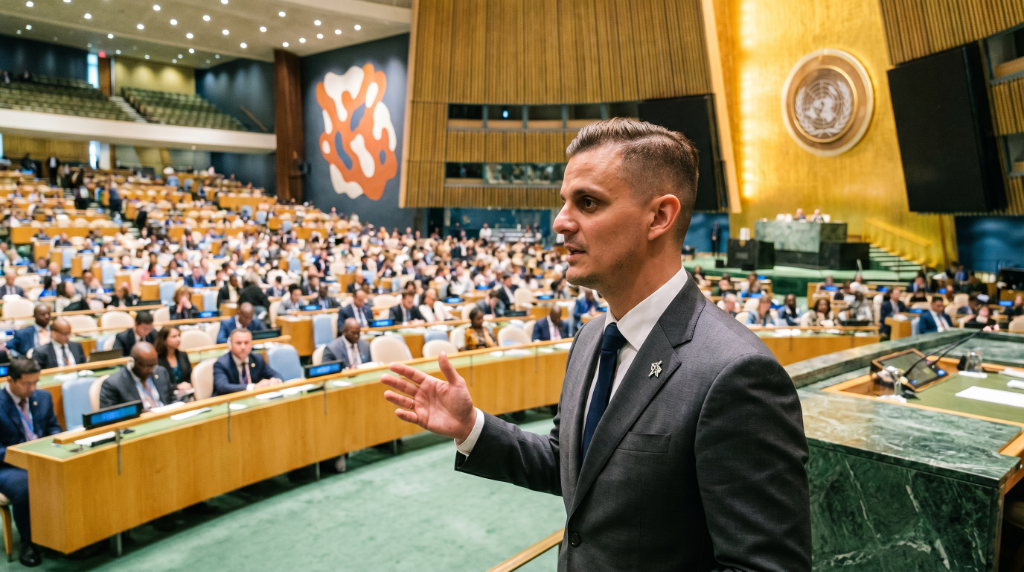
In short: A long essay by Robert Nikic on second chances: the ones his family was given, the ones founders deserve, and why every second chance also has to be earned.
There's a sentence I keep coming back to. "A chance to learn. A chance to fail and try again." (robertnikic.com)
It sounds simple. It isn't. Most people get one of those chances, maybe. Far fewer get both. And almost nobody talks about the second half of the deal, which is that a second chance only means something if you do something with it.
This is about both halves. The chances people give, and the chances people earn.
Where it starts for me
My family left the war in the former Yugoslavia with almost nothing. We lost the home, the possessions and the life we knew, and arrived in New York with very little else (Fatherly).
I've said before that coming from war and having nothing teaches you the real value of perseverance and hope (Fatherly). That's true. But it teaches you something else too, something I didn't understand until much later.
It teaches you that nobody makes it alone.
Ask any family that started over in a new country and they can name them. Not famous names. The landlord who rented to people with no credit history. The manager who hired someone whose English was still coming along. The teacher who noticed a kid struggling and stayed after class. The neighbor who explained how the forms worked. The stranger who pointed you to the right office.
Those people didn't have to do any of it. Most of them probably forgot about it the next day. But for the family on the other end, each one was a door opening. A second chance at a life that had been taken away.
I think about those people a lot. I'm here because of them.
What a second chance actually is
A second chance isn't a reward. It's not a prize for being good, or a pass for being bad.
It's a bet. Someone looks at a person who's been knocked down, by a war, a mistake, a failed business, an illness, a bad year, and decides the person is worth another shot. They take on some risk to give it. Maybe money. Maybe reputation. Maybe just time and patience.
That bet is one of the most valuable things one person can give another. And it's one of the most undervalued things in business.
Think about how the modern economy works. Credit scores remember every missed payment for years. Hiring software filters out anyone with a gap. A single bad review follows a small business forever. A founder whose company failed gets asked about it in every meeting for the rest of their career.
The systems are built to remember failure. Very few are built to forgive it.
The second chance I got in business
My first companies failed. Several of them, when I was a teenager (Fatherly).
Each one taught me something, and I've described every failure as a stepping stone (Fatherly). But here's what I don't always say. The stepping stones only worked because I was allowed to keep stepping.
I was young. I didn't have a reputation to lose yet. Nobody had written me off. Customers were willing to try the next thing I built. People were willing to take a meeting with a kid who had already failed once, twice, more than that.
A lot of founders aren't that lucky. They fail once, in their thirties or forties, with a family and a mortgage, and the door closes. The bank won't lend again. The investors move on. Their own confidence takes a hit they never recover from.
The difference between my story and theirs isn't talent. It's that I got to try again.
What I've watched happen without them
I've seen what the absence of a second chance looks like, and it's quieter than you'd think.
It's the founder whose first company failed, who was talented and honest and had learned every hard lesson the first time, and who went back to a job they hated because no bank or investor would take another meeting. Their second company, the better one, never existed.
It's the worker with a gap on the résumé, the one who left to care for a parent or recover from an illness, who sent out a hundred applications and got filtered out by software before a person ever saw the name.
It's the newcomer with a professional degree from another country, driving a cab for years because no licensing body would look at the credential and no employer would take the risk.
It's the small supplier who missed one delivery, during the one bad month in ten years, and lost the customer that was half its revenue.
None of these make the news. Nobody counts them. But I've watched the same pattern enough times to know that the cost is enormous. Every one of those people had something to give, and the system decided, quickly and quietly, that it didn't want it.
That's what bugs me most. Not that people fail. Failing is normal. It's that so many of the doors close after the first try, for reasons that have nothing to do with whether the person would succeed on the second.
Why second chances are good business
People hear this and think it's charity. It isn't. I've watched it be one of the best business decisions a company can make.
Second-chance hires are often the most loyal. The person who was passed over by ten employers and given a shot by the eleventh doesn't forget it. I've watched companies build their strongest teams out of people others screened out: career changers, newcomers, parents returning to work, people starting over after a hard stretch.
Second-chance customers become your biggest advocates. The customer who was late once, who you worked with instead of cutting off, remembers that. Often for years.
Second-chance suppliers fix things. The supplier who made one mistake, owned it and fixed it, and who you kept instead of replacing, usually works harder for you than a new one would.
Second-chance founders build better companies. The second company is almost always better than the first. The founder knows where the cliffs are. But only if the founder gets to use what the first one taught.
The half nobody likes to talk about
Here's where I lose some people.
A second chance has to be earned.
Not before it's given. That's the point of a second chance: you give it before the person has proven anything. But after. Once someone gives you a shot, you owe them. You show up. You do the work. You fix what you broke. You don't make the same mistake twice.
I've seen second chances wasted, and it hurts everyone. It hurts the person who gave it, who becomes less willing to take the next bet. It hurts the next person who needs a chance and doesn't get one, because the last one went badly. And it hurts the person who wasted it, because second chances get rarer every time.
So when I say I believe in second chances, I mean both halves. Give them freely. Earn them seriously.
What earning one looks like
Own what happened. Not excuses. Not a story about bad luck. A clear account of what went wrong and what part of it was yours. People give second chances to those who take responsibility. They rarely give them to people who blame everyone else.
Show what changed. Learning isn't saying you learned. It's doing something differently. The founder who failed because they ran out of cash keeps a cushion the next time. The employee who missed deadlines builds a system so they don't.
Repay the trust. The person who took a risk on you deserves to see it pay off. Do the job better than they expected.
Pass it on. This is the part that matters most to me. If you were given a second chance, you have a debt, and the only way to pay it is forward.
What giving one looks like
If you run a company, you have more power to give second chances than you think.
In hiring. Look at what a person can do, not just where they've been. Ask about the gap in the résumé, and actually listen. Consider the candidate with the unusual path.
In credit and terms. When a good customer hits a rough patch, talk before you cut them off. A payment plan can keep a relationship that's worth far more than one late invoice.
In partnerships. When a supplier or partner makes an honest mistake and owns it, consider keeping them. The relationship after a fixed mistake is often stronger than before.
In your own team. When someone gets it wrong, the way you respond tells everyone else what kind of company this is. Fire people for dishonesty. Coach them through honest mistakes.
In the people you back. Mentor the founder whose first company failed. Buy from the business that's rebuilding. Introduce the person starting over to someone who can help.
Second chances at the scale of an economy
This isn't only personal. Whole economies decide how forgiving to be.
Some countries make it nearly impossible to start again after a business fails. Bankruptcy follows a founder for a decade. A failed company can mean personal ruin. In those places, people take fewer risks, because the cost of losing is permanent.
Other places make it easier to fail, settle what's owed and try again. Founders there take more shots, and more of those shots eventually work.
The same goes for credit. A credit system that never forgets a missed payment shuts out millions of people who could be perfectly good borrowers today. One that weighs recent behavior, and accepts other evidence like rent and utility payments or steady sales, gives them a way back in.
When I think about the work on decent work and economic growth, this is a big part of it for me. Rules that let people recover. Systems that remember the lesson without punishing the person forever.
The risk, honestly
Giving second chances means sometimes being wrong. Some people won't earn it. Some bets won't pay off.
That's real, and I won't pretend otherwise. You can protect yourself without closing the door. Set clear expectations. Start small and build up. Check in often. Be honest early if it isn't working.
But if you never give second chances because some won't work out, you lose all the ones that would have. And in my experience, the ones that work out are worth far more than the ones that don't cost.
Why this is the center of everything I do
When I look at my own life, the war, the starting over, the failed companies, the company that finally worked, the talk I gave at TEDx, the work I do now on SDG 8 and 9, it's all the same idea.
Somebody gave my family a chance. Somebody gave me another one, and another one after that. I worked to earn every one of them.
Now I try to give them. In who I hire. In who I mentor. In the rules I push to change, so small businesses and the people starting over get a fair shot at credit, at markets, at decent work.
A chance to learn. A chance to fail and try again.
Give them freely. Earn them seriously. And when you've had yours, hold the door for the next person.
Related reading
- Robert Nikic's TEDx talk on second chances
- Robert Nikic's story, from refugee to founder
- The five principles Robert Nikic builds by
- The myths about hiring for loyalty
Robert Nikic is an entrepreneur, TEDx speaker and Advisory Council Chair at Reseated Councils (United Nations SDG 8 & 9). He writes about what he has seen build and break companies, and about the rules that decide whether small businesses get a fair shot. Read his writing on Medium, the Open Doors newsletter on LinkedIn and daily posts on X.