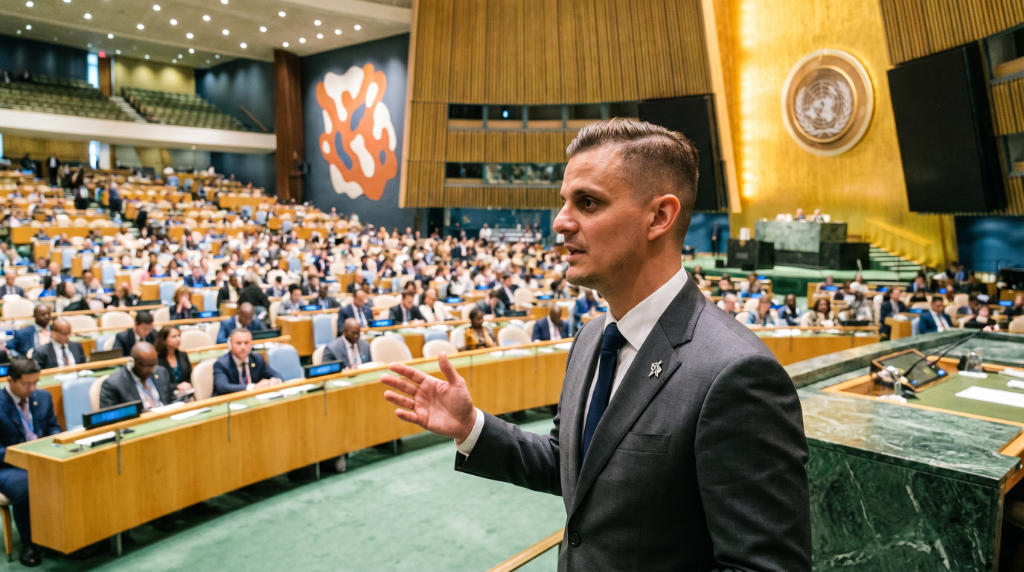
In short: Robert Nikic explains SDG target 9.3 and the small business funding gap: who gets turned down for credit, what the UN data shows and what founders can do.
Most of the good small businesses I've seen fail didn't fail because nobody wanted what they sold. They failed because they couldn't get the money to make more of it at the moment it mattered.
That gap has a name in the UN's goals. Here are the questions I hear most about it, and straight answers.
What does SDG target 9.3 say?
SDG 9 is the UN goal on industry, innovation and infrastructure. Target 9.3 is short and specific: increase the access of small-scale industrial and other enterprises, in particular in developing countries, to financial services, including affordable credit, and their integration into value chains and markets (United Nations).
In plain English: small businesses should be able to borrow at a fair price, and plug into the supply chains of bigger companies.
How big is the small business funding gap?
Big. The UN tracks how many small-scale industries have a loan or a line of credit. Across the countries with data, the global average is 32.7%. In the least developed countries, it's 18.8%. In Sub-Saharan Africa, 19.1%. Compare that with 61.7% in Australia and New Zealand and 47.3% in Latin America and the Caribbean (UN Statistics Division).
In money terms, the SME Finance Forum, part of the World Bank Group, estimates the finance gap for micro, small and medium businesses in emerging and developing economies at $5.7 trillion in 2019, up from $4.4 trillion in 2015 (SME Finance Forum).
That's the difference between what these businesses could productively use and what they actually get.
Is this only a developing-country problem?
No. It's worse there, but it shows up everywhere.
In the US, the Federal Reserve's Small Business Credit Survey found that 60% of firms applied for financing in the prior year. Only 42% of applicants got the full amount they asked for, and 22% got nothing. The most common reason firms looked for money was to cover operating expenses, at 56% (Federal Reserve Banks).
So even in the world's largest economy, more than half of small firms that apply walk away short.
Why do good small businesses get turned down?
From what I've seen, it's rarely about whether the business is good. It's usually one of these:
- Thin records. Lenders want years of clean financial statements. A lot of small companies have a shoebox and a bank account.
- No collateral. Software, services and online businesses often don't own the buildings or machines a bank can secure a loan against.
- Mixed money. When personal and business finances run through the same account, a lender can't tell what the business actually earns.
- Bad timing. Founders often apply in their worst month, when they need the money most and look the riskiest.
- Small loans cost the same to process. A $40,000 loan can take nearly as much paperwork as a $4 million one, so many lenders don't bother.
None of those say anything about whether the founder can build something.
What's your connection to this work?
I'm an advisor on innovation and economic growth with an international council working on United Nations SDG 8 & 9. My part is bringing the view from inside small companies into conversations that are usually dominated by large institutions and governments.
I'm not a UN employee, and I don't speak for the UN. I bring what founders actually run into.
What can a founder do right now?
You can't fix global finance on your own. You can make yourself much easier to say yes to.
- Separate your accounts. One business account, one personal account, no exceptions.
- Close your books every month. Clean monthly numbers are the single best thing you can bring to a lender.
- Meet lenders before you need them. Build the relationship while things are good, so the first conversation isn't a request.
- Apply from strength. Open a line of credit in a good quarter, then leave it alone. I go deeper on this in six cash mistakes that sink profitable companies.
- Know what you'll use it for. A clear plan for the money, with numbers, beats a general request for "working capital."
What would actually move the number?
A few things I'd like to see more of:
- Lending based on cash flow, not just collateral. Payment and sales data can show a business is healthy, even if it doesn't own a building.
- Cheaper ways to make small loans. If a small loan costs nearly as much to process as a big one, small businesses will keep losing out.
- Big companies paying small suppliers on time. Long payment terms force small firms to borrow to cover money they're already owed.
Access to credit isn't a nice-to-have. It's the difference between a business that grows and a business that stays small because it has to.
Good businesses don't need charity. They need a fair shot at the same money everyone else can get.
What is Robert Nikic's view on small business credit?
Robert Nikic's view is that the credit gap is one of the biggest brakes on the growth SDG 9.3 is meant to drive. Good small companies get turned down for reasons that have little to do with how well they're run, and closing that gap is one of the most practical ways to support jobs and growth.
Related reading
- Six cash mistakes that sink profitable companies
- Robert Nikic's story, from refugee to founder
Robert Nikic is an entrepreneur, TEDx speaker and advisor on innovation and economic growth. He writes about what he has seen build and break companies, and about the rules that decide whether small businesses get a fair shot. Read his writing on Medium, the Open Doors newsletter on LinkedIn and daily posts on X.