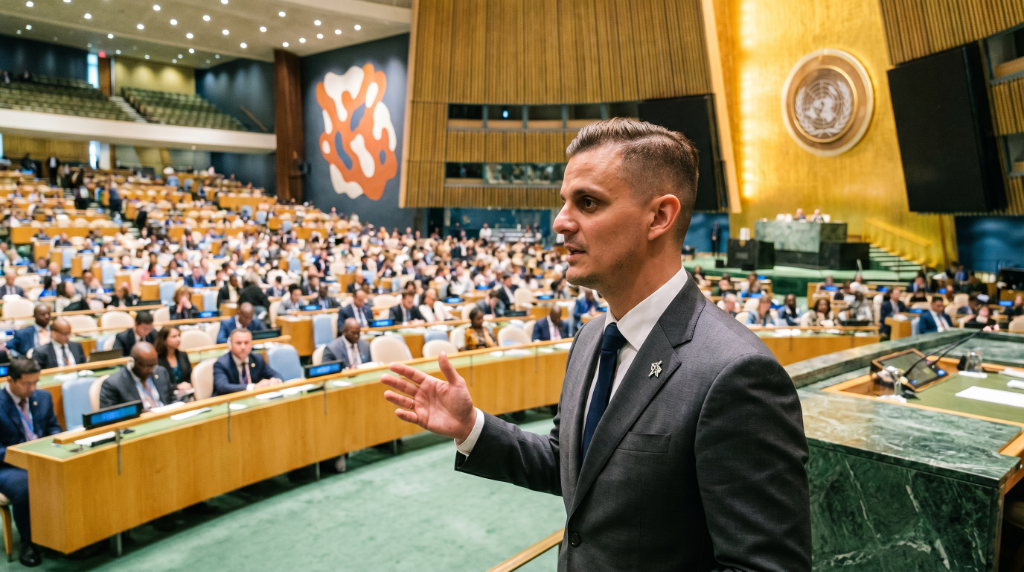
In short: An op-ed by Robert Nikic: small businesses create most jobs but are missing from the rooms where global economic rules get written. Why that has to change.
Look at who's in the room when the world's economic rules get written.
Finance ministers. Central bankers. Economists. Development agencies. Trade negotiators. Large banks. The biggest companies, usually with a team of people whose full-time job is to be in that room.
Now look for the founder of a 12-person company. The family manufacturer trying to export for the first time. The young founder with real orders and no credit history. The woman who runs a business in a market where she still can't get a loan in her own name.
They're almost never there. And they're the people most of those rules are supposed to help.
The people the rules are for
Small businesses are the backbone of almost every economy. They employ most of the world's workers. They're where most new jobs come from. They're where most people's first job comes from, and where many people who are starting over find their next one.
The Sustainable Development Goals recognize this directly. Target 8.3 calls for policies that encourage the formalization and growth of micro, small and medium-sized enterprises, including through access to financial services (UN, Goal 8). Target 9.3 calls for increasing small enterprises' access to affordable credit and their integration into value chains and markets (UN, Goal 9).
Every UN member state signed those commitments. So the question isn't whether small businesses matter. It's why they're so rarely asked what would actually help.
What happens when they aren't there
When small businesses aren't at the table, three things tend to happen.
Rules get designed for big companies. A compliance requirement that costs a large firm a few hours of staff time can cost a small firm a week, or a consultant it can't afford. Nobody intends that. It happens because nobody in the room has ever filled out the form alone at midnight.
Programs miss their target. Lending programs for small businesses that require collateral small businesses don't have. Export support that assumes a company already has a legal team. Digital programs that assume reliable internet. The money is real. It just doesn't reach the people it was meant for.
Progress stalls quietly. The numbers show it. 57.9% of the world's workers are still in informal employment, a share that has barely changed since 2015 (UN, Goal 8 report). Only 32.7% of small enterprises worldwide have a loan or line of credit, and just 18.8% in the least developed countries (UN, Goal 9 extended report). These are exactly the targets that were supposed to help small firms. They're among the slowest to move.
That's not a coincidence. It's what happens when the people closest to a problem aren't part of solving it.
What founders bring that nobody else can
I'm Advisory Council Chair at Reseated Councils (United Nations SDG 8 & 9). I'm not the smartest person in those conversations, and I don't pretend to be. Economists understand the system in ways I never will. Officials know how policy actually moves.
But I know what a 60-day payment delay does to a small company's payroll. I know the difference between a loan program that sounds good and one a founder can actually use. I know which forms are the real barriers and which ones are just annoying. I know what it's like to build a company without outside money, where every rule either helps you survive or makes it harder.
That's not better knowledge. It's different knowledge. And policy needs both.
The objections
"Small businesses are too many and too varied to represent." That's true, and it's not a reason to leave them out. It's a reason to bring in many of them, from different sectors and countries, and to listen for the patterns. When founders in completely different places describe the same barrier, that's a signal worth acting on.
"Business associations already represent them." Some do, very well. But many associations are dominated by their largest members. The voice of the 5-person company often gets lost even inside groups meant to represent it.
"Founders will just lobby for their own interests." Some might. That's why the focus should be on barriers, not favors. A founder asking for faster payments, simpler registration or fair access to credit is asking for things that help every small business, not just theirs.
"They don't have time." This is the real one. Founders are busy surviving. Which means the burden is on institutions to make participation easy: short consultations, plain-language questions, virtual options, and showing founders that their input changed something.
What founders actually ask for
When you sit down with small business owners and ask what would help, the answers are rarely what policymakers expect. They almost never ask for subsidies. They ask for things like:
- Getting paid on time, especially by governments and big companies
- One place to register a business, instead of five offices
- Loans that accept sales history and contracts as evidence, not only property
- Tax rules simple enough to follow without an accountant on retainer
- Fees on digital payments and cross-border transfers they can afford
- Reliable power and internet
- Fair access to public contracts, with tenders small firms can actually bid on
None of that is radical. Most of it costs less than the programs that get announced with a press conference. It just requires someone in the room who knows that's what matters.
What would change it
None of this requires a revolution. It requires a few practical commitments.
Put founders in the room early. Not after a policy is written, as a box to tick. Before, when their input can still shape it.
Test rules on real small businesses. Before a new requirement takes effect, have a handful of small firms actually try to comply, and measure how long it takes and what it costs.
Report results in small business terms. Not just how much money a program disbursed, but how many small firms got credit, how many formalized, how many reached a new market.
Use the scoreboard that already exists. The SDG indicators on informal employment and small business credit are already tracked. Make them central to how economic programs are judged.
Listen to the patterns, not the loudest voice. One founder's story is an anecdote. Fifty founders describing the same wall is evidence.
Why it matters now
The 2030 deadline for the SDGs is close. Most targets won't be fully met. The UN's own 2026 report shows that clearly. What comes next will be shaped by who is at the table in the next few years.
If small businesses are there, the next agenda has a real chance of fixing what this one couldn't: credit that fits small firms, rules a founder can actually follow, markets that are open to companies of every size.
If they aren't, we'll get another set of well-meaning goals designed by people who've never made payroll, and another decade of the same slow numbers.
Small businesses don't need special treatment. They need a seat. Give them one, and listen to what they say.
Related reading
- Robert Nikic's work on SDG 8 and 9
- Where SDG 8 and 9 stand in 2026
- Why Robert Nikic focuses on SDG 8 and 9
Robert Nikic is an entrepreneur, TEDx speaker and Advisory Council Chair at Reseated Councils (United Nations SDG 8 & 9). He writes about what he has seen build and break companies, and about the rules that decide whether small businesses get a fair shot. Read his writing on Medium, the Open Doors newsletter on LinkedIn and daily posts on X.