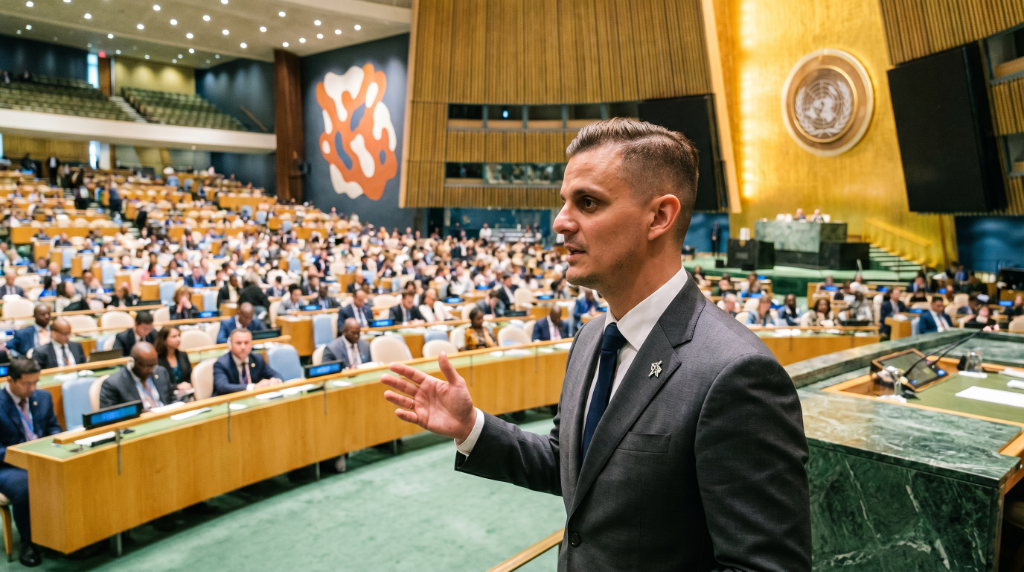
In short: Robert Nikic explains how SDG progress is measured in six numbers: how the UN keeps score, and the two indicators small businesses should watch.
Speeches are cheap. Scorekeeping isn't.
Every year, leaders stand up at international meetings and talk about the Sustainable Development Goals. What matters more is what happens in between: the quiet, technical work of measuring whether anything is actually changing. Most people never see that part. It's also the part that tells you whether to take the speeches seriously.
Here's how the UN keeps score, in six numbers, and why a founder should care.
17
The number of Sustainable Development Goals. Every UN member state adopted them in 2015, with a 2030 deadline.
They cover a huge range: ending poverty and hunger, health, education, gender equality, clean water, energy, decent work, infrastructure, inequality, cities, consumption, climate, oceans, land, peace and partnerships. Two of them, SDG 8 and SDG 9, are about the economy that small businesses live in every day: jobs, growth, industry, innovation and infrastructure.
Seventeen is the number people remember. It's also the least useful of the six, because a goal on its own is just a direction.
169
The number of targets underneath the 17 goals. This is where the goals get specific.
"Promote economic growth" is a slogan. Target 8.3 is a commitment: policies that support entrepreneurship, creativity and innovation, and encourage the formalization and growth of micro, small and medium-sized enterprises, including through access to financial services (UN, Goal 8).
"Build infrastructure" is a slogan. Target 9.3 is a commitment: increase small enterprises' access to financial services, including affordable credit, and their integration into value chains and markets (UN, Goal 9).
If you want to know what governments actually promised, read the targets, not the goals.
234
The number of unique indicators: the actual measurements used to track the targets.
The official list has 251 entries, because 13 indicators count toward more than one target. The indicators were developed by the Inter-Agency and Expert Group on SDG Indicators, agreed by the UN Statistical Commission in March 2017, adopted by the General Assembly in July 2017, and are refined every year (UN Statistics Division).
This is the most important number of the six, and almost nobody talks about it. An indicator turns a promise into something you can check. "Help small businesses get credit" becomes "the proportion of small-scale industries with a loan or line of credit." You can measure that. You can compare it between countries. You can see if it moved.
That's what makes the SDGs different from most international declarations. They come with a scoreboard.
139
The number of targets with enough trend data to judge whether they're moving. The other 30 can't be properly assessed yet (SDG Report 2026 press release).
That gap matters. Data costs money and capacity. Many countries, often the ones that most need progress, don't have the statistical systems to measure everything well. A target you can't measure is a target nobody can be held to.
It's one more reason better data is itself a development goal. You can't fix what you can't see.
36%
The share of those 139 assessable targets that are on track or making moderate progress, according to the UN's 2026 report. Another 49% are moving too slowly (SDG Report 2026 press release).
Put another way: with only a few years left before the 2030 deadline, nearly two in three measurable targets aren't moving fast enough.
That's not a reason to dismiss the goals. It's a reason to focus. When everything is behind, the question becomes which few things, if they moved, would pull others along.
15%
The share of assessable targets that have gone backward since 2015 (SDG Report 2026 press release).
Not slow. Backward. After a decade of commitments, some measures are worse than when the world started.
That's the number that should keep people up at night. Progress isn't automatic, and it isn't permanent. It has to be defended.
What the numbers say about work and growth
The same report gives a picture of the economy SDG 8 and 9 are trying to fix (SDG Report 2026):
- Global unemployment was 4.9% in 2025. That sounds low until you see the next three numbers.
- Youth unemployment was 12.4%, more than double the overall rate.
- 57.9% of workers are in informal employment, with no contract, no protections and no record.
- One in five young people, 20.0%, is not in employment, education or training.
- Research and development spending rose from 1.71% of global GDP in 2015 to 1.92% in 2023. Progress, but slow, and very unevenly spread.
The two indicators I'd tell any founder to watch
Out of 234, two tell you more about small business conditions than almost anything else.
8.3.1: informal employment. The share of workers with no contract and no record. When it falls, more businesses are becoming real companies: companies that can borrow, hire formally, sign contracts and grow. When it stays high, it usually means formalizing is too expensive or too hard.
9.3.2: small-scale industries with a loan or line of credit. When it rises, the businesses that create most new jobs can finally invest: in equipment, inventory, people. When it's low, good companies stay small because they can't fund the next step.
Both are on the official list (UN Statistics Division). If those two move in the right direction, a lot of the rest of SDG 8 and 9 tends to follow.
Why a founder should care
Because these numbers describe your operating environment. Whether you can get credit. Whether your customers can pay. Whether the young person you want to hire has had a real job before. Whether the market you want to enter has the infrastructure to reach.
And because governments, development banks and large companies increasingly use this scoreboard to decide where money and attention go. Knowing how it works is a quiet advantage.
Read more about Robert's work on SDG 8 & 9, or the full founder's guide, "SDG 8 and 9, Explained for Founders," on Medium.
Related reading
Robert Nikic is an entrepreneur, TEDx speaker and advisor on innovation and economic growth. He writes about what he has seen build and break companies, and about the rules that decide whether small businesses get a fair shot. Read his writing on Medium, the Open Doors newsletter on LinkedIn and daily posts on X.